Part of: Around Choeng Mon
The Giants at the Temple Gate: Who the Yak Are
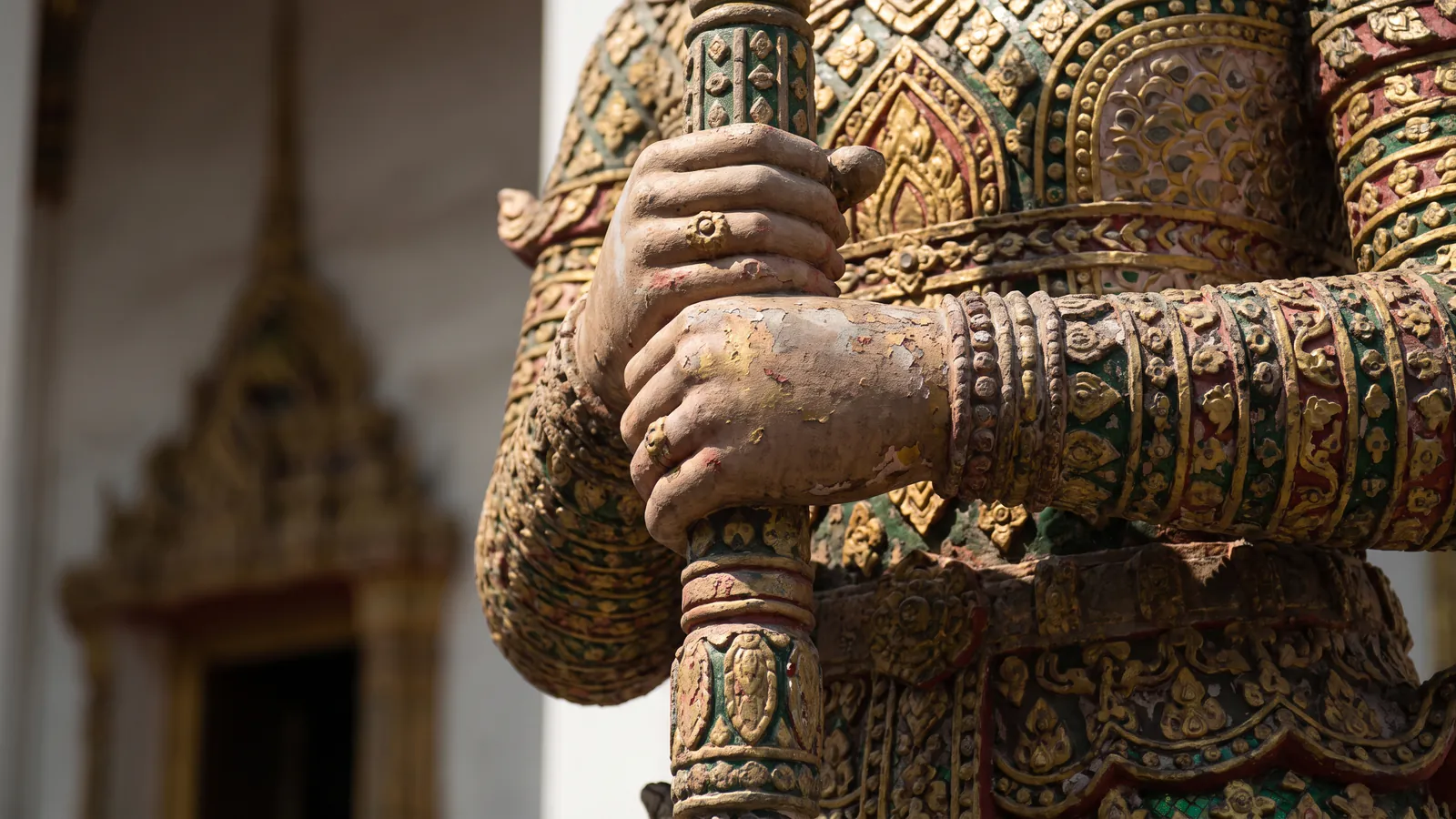
The giant statues at Thai temple gates are yak, the Thai form of the yaksha of Indian and Buddhist myth, set there as door guardians. At Wat Phra Kaew and Wat Arun in Bangkok they are named characters from the Ramakien, the Thai Ramayana, and their colour and costume tell you who each one is. They were set at the threshold to guard what lies inside.
This guide explains what a yak is, why one guards a gate, how to start telling the characters apart, where the famous ones stand, and how not to confuse them with the Chinese stone warriors that stand at some of the same temples.
What a yak is
ยักษ์ (yak) is the Thai form of the Sanskrit word yaksha; the Pali equivalent is yakkha. In everyday Thai, yak also simply means a giant, or something very big. So when a guide points at a towering painted figure and calls it a yak, the word is doing two jobs at once: it names a creature of myth, and it describes its size.
In Buddhist texts, yak are a class of non-human beings. Some are hostile and some are protective, and they serve Vessavana, the king of the yak. In one text, the Atanatiya Sutta, Vessavana offers the Buddha protective verses against beings that harass monks and lay followers. A yak, in other words, is neither simply a demon nor a god. It is a powerful being of a kind the texts describe as either dangerous or protective, and it is the protective side you meet at a temple gate.
Why a giant guards the gate
Thai has a word for the job: ทวารบาล (dvarapala), a guardian of a door or entrance. Thai reference sources describe the dvarapala as often a warrior or a fearsome-looking giant, and usually armed. The yak is the most dramatic version, but not the only one, as the section on Chinese stone guardians below explains.
Why a giant? It is traditionally believed that the yak at a temple gate have the power to drive away ghosts and spirits, so that what lies inside stays protected. That is a belief handed down from earlier generations and repeated in Thai writing about the statues. It is worth knowing as the reason they were put there, not as a claim about what they do.
There is a second, more literary idea. The record on the Wat Phra Kaew giants kept by the Princess Maha Chakri Sirindhorn Anthropology Centre (SAC), part of Thailand's Ministry of Culture, points out that the giants are antagonists from the Ramakien, the opponents of the story's hero, placed on guard at a Buddhist monastery. It suggests this may imply a moral: that good always wins over evil. The record itself says "may", so treat it as one reading rather than a settled meaning. It is a good one to have in mind as you walk past.
The Ramakien cast
The Ramakien (รามเกียรติ์) is the Thai version of the Ramayana, the Indian epic. Its standard Thai text was compiled under King Rama I. Many of the giants you see at the royal temples are not generic monsters but particular characters from it, each with a name.
The one to learn first is ทศกัณฐ์ (Thotsakan), the Ramakien's Ravana: the king of Longka, with ten faces and twenty arms. His body is usually shown green.
Each character has a look of its own. In khon, the Thai masked dance drama, the masks differ in shape, colour and detail according to the character, and the gate giants follow the same logic. Face colour, crown, costume, the weapon in hand and the way the figure stands all help tell one giant from the next.
Where to see the famous ones
Three sets are worth looking for if you pass through Bangkok, and one old story connects two of the city's temples.
Wat Phra Kaew
At Wat Phra Kaew, the Temple of the Emerald Buddha, twelve yak stand in six pairs on the inner side of the gallery entrances, facing the ordination hall. They are made of stucco covered in glazed porcelain, and each wears its own crown and costume, down to pointed sandals. The SAC record says that most of them probably date from the reign of Rama III, with the rest made under Rama V, and that all of them were restored for the 1982 bicentenary celebrations.
| Thai | Romanised (SAC) |
|---|---|
| สุริยาภพ and อินทรชิต | Suriyaphop and Intharachit |
| มังกรกัณฐ์ and วิรุฬหก | Mangkonkan and Wirunhok |
| ทศคีรีธร and ทศคีรีวัน | Thotsakhichanthon and Thotsakhiriwan |
| จักรวรรดิ and อัศกรรณมาราสูร | Chakrawat and Atsakanmarasun |
| ทศกัณฐ์ and สหัสเดชะ | Thotsakan and Sahatsadecha |
| มัยราพณ์ and วิรุญจำบัง | Maiyarap and Wirunchambang |
Spellings vary between sources, in Thai script as well as in English. The SAC record's own Thai text names one giant ทศคีจันธร, which is where its Thotsakhichanthon comes from; the Thai Wikipedia plan calls him ทศคีรีธร (Thotsakhirithon). Time Out writes Asakanmala for Atsakanmarasun. So if a sign or a guidebook spells a name a little differently, it may still be the same giant.
Wat Arun
At Wat Arun, two giants stand at the ordination hall gate: a white one, สหัสเดชะ (Sahatsadecha), and a green one, Thotsakan. Both are stucco covered in glazed tiles, and both stand with their hands resting on a club. Sahatsadecha is another giant of the Ramakien. Thotsakan you have already met, and here the green body is the clue.
Suvarnabhumi Airport
If you fly out through Bangkok, look for twelve giant statues in the fourth-floor departure hall at Suvarnabhumi Airport. They are replicas of the Wat Phra Kaew giants, so the table above is a fair starting point for them too, and they make a good last look at the Ramakien cast before your flight.
The legend of Tha Tian
Wat Pho tells a story about its own giant and the one at Wat Chaeng, the temple across the river better known today as Wat Arun. In the legend, the two giants were close friends until Yak Wat Pho failed to pay back money he had borrowed. They fought, and the fight devastated the area around them. Phra Isuan heard of the trouble they had caused, cursed them both into stone, and set each one to guard its own temple.
The flattened ground has been called ท่าเตียน (Tha Tian) ever since; the temple glosses the name as "flattened ferry". It is a legend, not history, but it is the story Wat Pho itself tells about its gate giants.
Yak or Chinese stone guardian?
Not every guardian at a Thai temple gate is a yak. Dvarapala can also be deities, foreigners or the mythical animals of Himmapan, and some temples have Chinese-style guardians as well. A common mix-up is between yak and Chinese stone figures, and Wat Pho is where it happens.
The large armed stone warriors at Wat Pho are ลั่นถัน (Lan Than): Chinese guardian figures in Chinese opera-style costume and close-fitting armour, each holding a weapon in one hand, placed as gate guardians. Some of the temple's Chinese stone figures are often said to have arrived as ballast in ships trading from China, before being put to use as decoration around the grounds. The temple also identifies four pairs of Chinese figures in European clothes as Marco Polo.
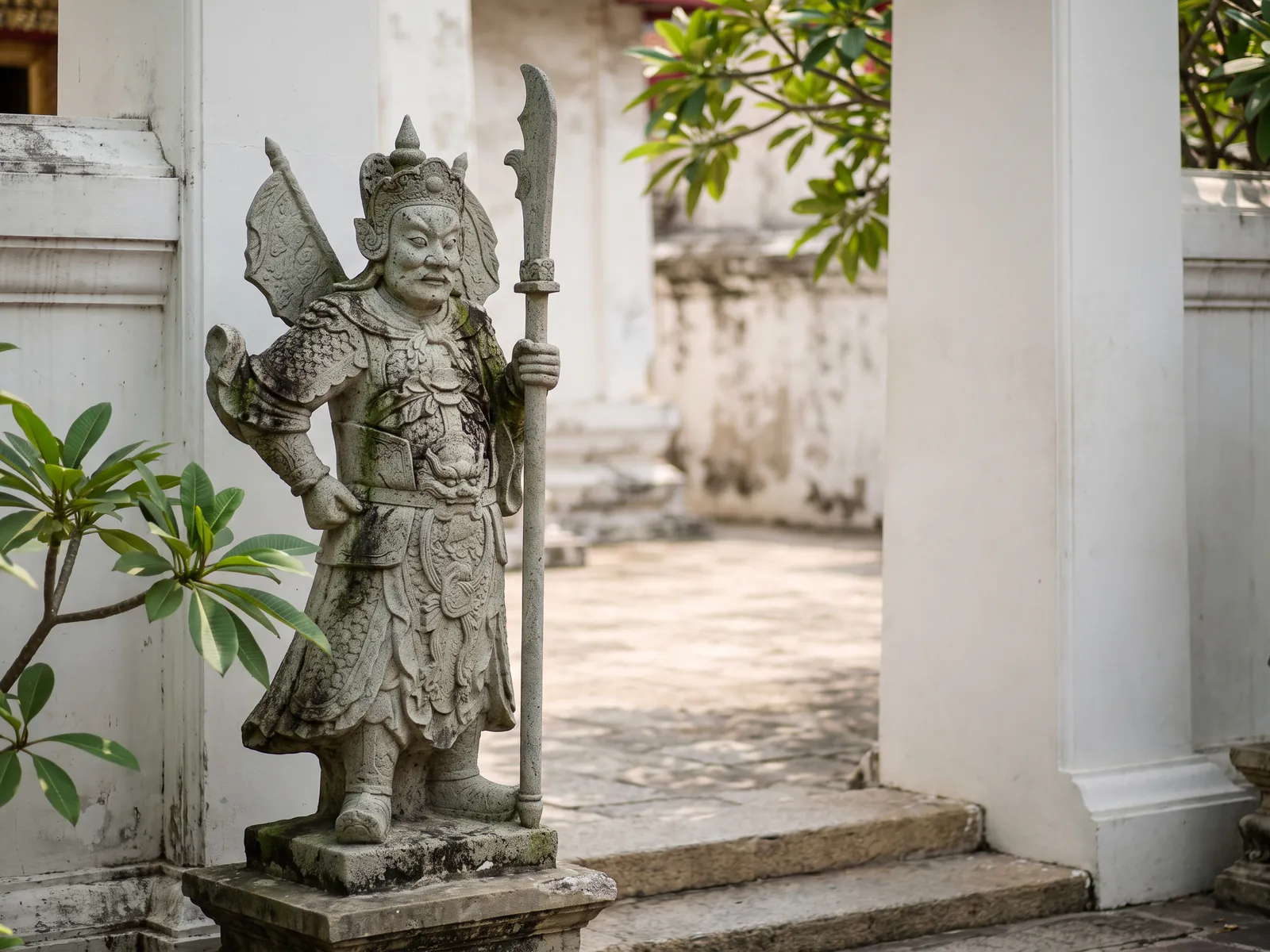
Wat Pho's own yak are something else: a few small pairs at the entrance gate of the Phra Mondop, the scripture library. The temple notes that visitors often mistake the big Chinese stone figures near the entrance for them.
| Look at | Yak | Chinese stone guardian |
|---|---|---|
| Material | Stucco covered in glazed porcelain or tile, in strong colours | Carved stone |
| Dress | Thai crown and costume, pointed sandals | Chinese opera-style costume and armour |
| Weapon | A club at Wat Arun, held with both hands | A weapon held in one hand |
| Origin | Characters from the Ramakien, the Thai epic | Brought from China, often said to have come as ballast |
| Where to compare | Wat Phra Kaew, Wat Arun, the Phra Mondop gate at Wat Pho | The large stone warriors at Wat Pho |
Thao Wessuwan is a different figure
One more name causes confusion. ท้าวเวสสุวรรณ (Thao Wessuwan), the Vessavana of Pali-based English, is the king of the yak and the guardian of the north, one of the four world-guardians. He is not Thotsakan, and he is not one of the gate pairs at Wat Phra Kaew or Wat Arun, although they are sometimes confused online. Thao Wessuwan has become a popular figure of devotion in recent years, with statues of his own at some temples. He is best understood on those terms, as a figure in his own right, rather than as another name for the giant at the gate.
If you visit a temple
Wherever you meet a gate guardian, in Bangkok or anywhere else, treat it as part of the temple: look, take your photographs, and do not climb on the statue or sit on it. That is ordinary courtesy rather than a posted rule. If you are staying near Choeng Mon, our guide to Big Buddha and Wat Plai Laem covers the two nearest temples and how to dress for a visit.
Why a restaurant took the name
Khun Yak, the Thai restaurant in Choeng Mon, takes its name from these guardians. The idea is the one at the gate: someone stands watch so that what happens inside is done properly. The short version of that story is on our about page.