How a Thai Meal Works: Sharing, Rice and the Table
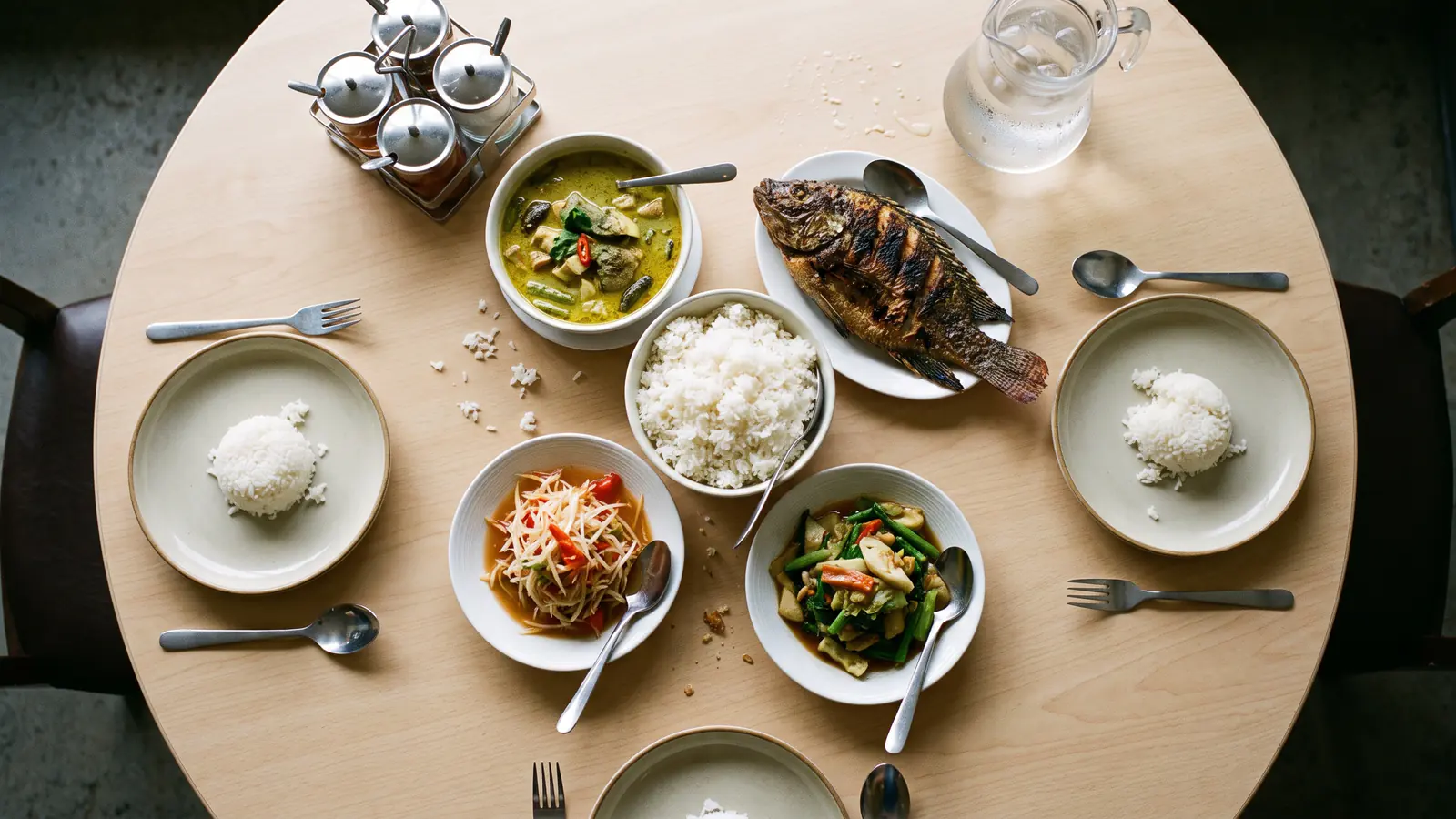
A Thai meal is not built the way a Western one is. There is no starter and main for each person. The dishes go in the middle of the table, there is rice for everyone, and each person puts together their own plate as the meal goes on. Once that shape is clear, most of the questions about what to do with your hands, or how much to order, answer themselves.
This guide covers what to expect and how the meal is usually eaten, with each point tied to a source. Where something is only a rule of thumb, or comes from travel writing rather than anything official, it says so. The short version is that there is less to get wrong than most lists suggest. For the words to ask for things at the table, see our guide to ordering food in Thai.
What actually arrives at the table
Thai meals typically consist of rice with several dishes shared by everyone, according to Wikipedia's account of Thai cuisine. The dishes are placed in the middle, and each person takes a little from one and then another onto their own plate of rice. The same source describes the dishes as served together, soups included, so there is no sequence of courses to follow.
In a restaurant it can look a little different from that description, because a kitchen cooks dish by dish. Expect the table to fill over a few minutes rather than in one wave. That is the kitchen working, not something going wrong.
Noodles are the main exception to sharing. The same source notes that Thai noodle dishes, whether stir-fried like pad thai or served in a soup, usually come as an individual serving and are not meant to be shared. Ordering a plate of noodles for yourself is entirely normal.
At southern Thai eateries, a plate of raw vegetables and herbs with nam phrik kapi, a chilli relish made with shrimp paste, is often served as a complementary dish. It sits alongside the other dishes rather than counting as a course of its own. For more on what makes cooking in this part of the country distinctive, see southern Thai food on Koh Samui.
Rice is the centre, and the dishes move around it
The Thai word for rice is khao (ข้าว), and the meal is organised around it. In the arrangement described above, the rice is the constant and the dishes are what changes from one meal to the next.
There is a word for how it is eaten: khluk (คลุก), mixing the flavours and textures of different dishes with the rice on your plate. Wikipedia calls it important to Thai dining. Taking a spoonful of curry, a piece of fish and some greens onto the same patch of rice, and mixing them, is the point of the arrangement, not a lapse in manners.
Sticky rice is a different case. In Lanna and Isan, in the north and north-east, it is shaped by hand into small balls and dipped into side dishes, and by custom only the right hand is used, according to the same source. If sticky rice arrives at your table, using your fingers is the traditional way to eat it. Ordinary steamed rice is the one that goes with the fork and spoon.
Fork in the left hand, spoon in the right
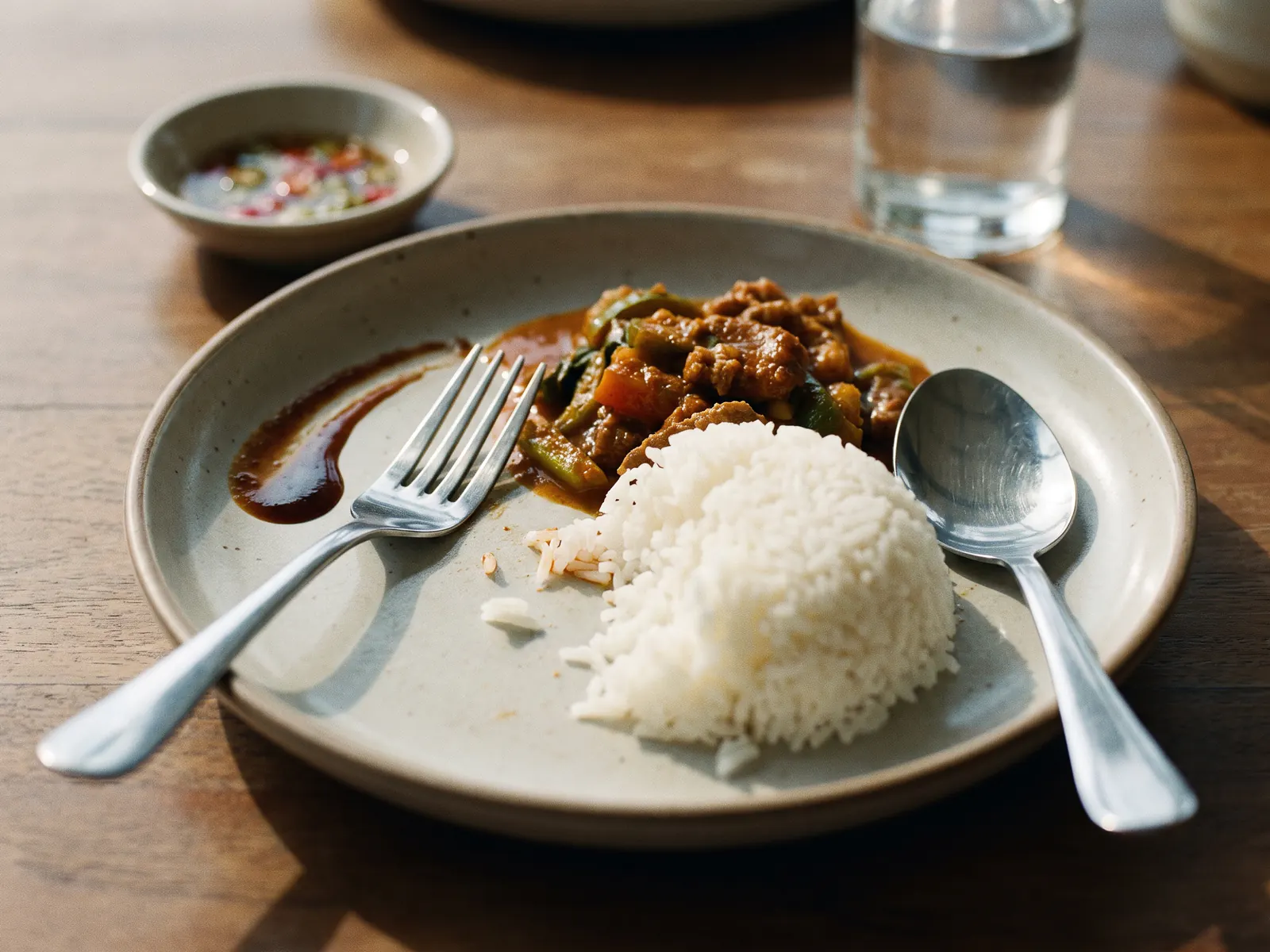
Thai food was traditionally eaten by hand, and most Thais today eat with a fork and spoon, introduced around King Chulalongkorn's return from a tour of Europe in 1897, part of a wider Westernising drive in the nineteenth century that also brought tables and chairs. So the cutlery is a little over a century old, which is a useful reminder that nobody is protecting an ancient ritual here.
The fork is held in the left hand and pushes food onto the spoon, held in the right, and the spoon is what goes to the mouth. Knives are not generally used at the table, so a Thai place setting does not include one. A traditional ceramic spoon is sometimes used for soup.
Chopsticks have a narrower role. The source describes them as foreign utensils to most ethnic groups in Thailand, used mainly for Chinese-style noodle soups and at Chinese, Japanese or Korean restaurants. Stir-fried noodles such as pad see ew and pad thai, and curry noodle dishes, are eaten with a fork and spoon in the Thai fashion. At a Thai table laid with a fork and spoon, those are the tools for the meal.
The caddy of sauces and seasonings
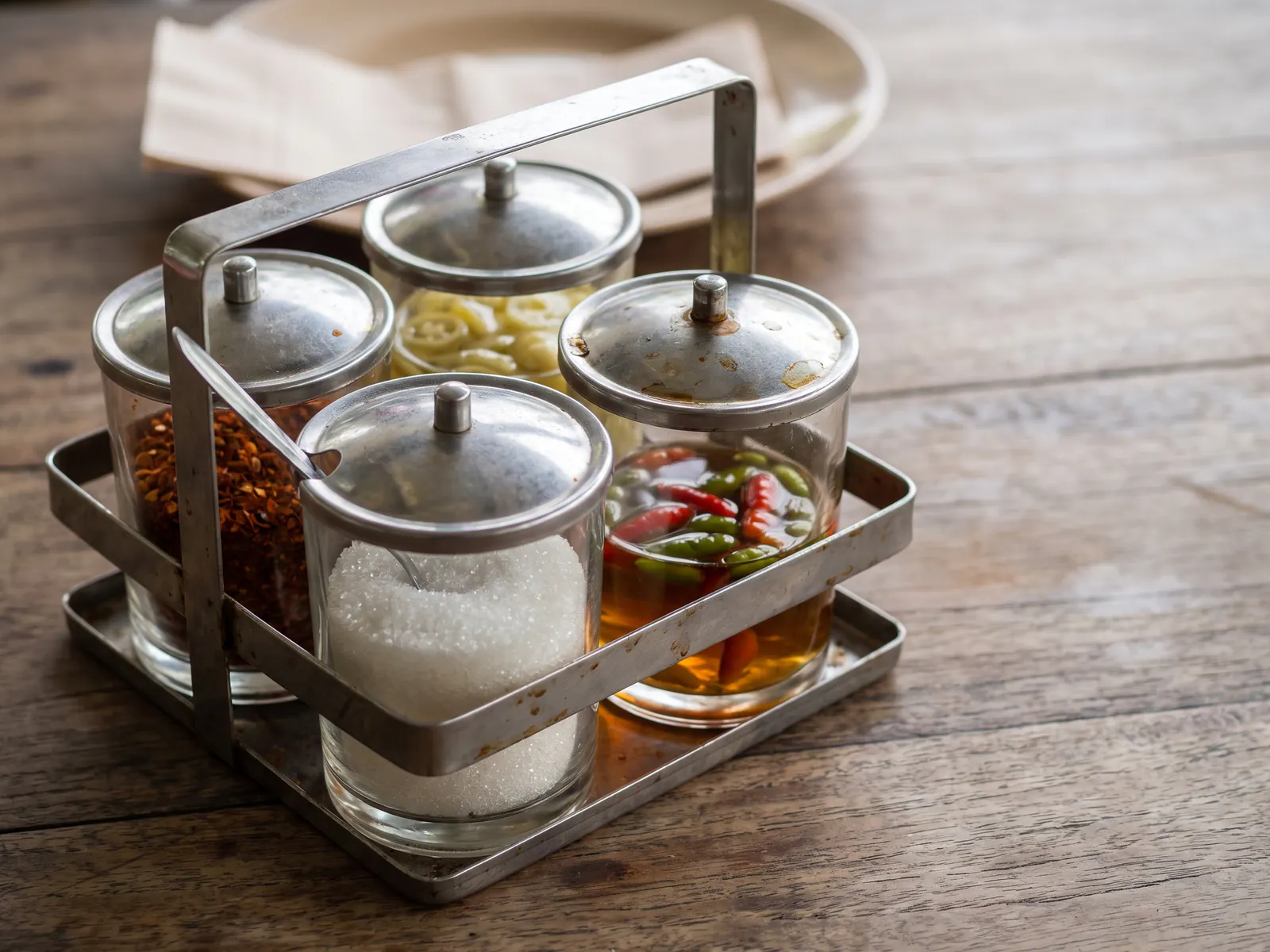
In most Thai restaurants, diners can reach a selection of table sauces and condiments, either brought by staff or already on the table in small containers. Wikipedia lists the usual contents: phrik nam pla (พริกน้ำปลา), which is fish sauce with lime juice, chopped chilli and garlic; dried chilli flakes; sliced chillies in rice vinegar; and sugar. Sweet chilli sauce and Sriracha sometimes appear too.
Salty, sour, hot and sweet each have their own pot, and seasoning at the table is left to the individual diner. A dish that arrives is a starting point for your own plate rather than a finished statement.
Chilli is in several of those pots, so taste before adding more. Our guide to Thai food spice levels goes into heat properly. Fish sauce is part of the standard set, which matters if you avoid animal products. The vegetarian and vegan guide covers what else to check.
How much to order for the table
The sourced part is a custom: it is usual to provide more dishes than there are guests at a table. From restaurant writing comes a rule of thumb that fits it, which is to order one dish per person plus one. Treat it as a starting point rather than a rule. Appetite, the size of the dishes and how rich they are will move the number up or down.
Variety matters more than the count. Wikipedia describes a Thai meal as rice with dishes that form a harmonious contrast of flavours, textures and cooking methods. A traditional meal has at least five elements: a dip or relish, a clear soup, a curry or stew, a deep-fried dish and a stir-fried dish. You do not need all five. Choosing across them, say a curry, a stir-fry, something fried and a soup, will usually serve a table better than four dishes of the same kind.
Eating alone or in a hurry is just as ordinary, and it is how most people eat earlier in the day too, as what Thai breakfast actually is describes. The same source notes that single dishes such as fried rice or noodle soups are quick and filling when time is short or you are on your own. Another common form is khao rat kaeng, a small helping of curry or a stir-fry served on a plate of rice. If you are ordering online for a group, the same thinking carries over: choose for the whole table and let people help themselves.
The bill, the service charge and tipping
According to ThaiPod101's guide to tipping in Thailand, sit-down restaurants, especially in malls, hotels and tourist areas, often add a service charge of around 10 per cent, with VAT, commonly 7 per cent, applied separately. It adds that, unlike VAT, the service charge is not clearly mandated by law. How the two stack up on a bill is worked through in our guide to what food costs on Koh Samui, so it is not repeated here.
The same guide says that at street food stalls and simple local shops, tipping is not expected, and rounding up or leaving small change is plenty if you want to show appreciation. At a restaurant, it suggests checking the receipt. If a service charge is listed, an extra tip is optional. If there is none and the service was very good, a small tip, often framed as 5 to 10 per cent in traveller guidance, is a reasonable gesture.