Southern Thai Food on Koh Samui: What It Is and What to Try
Koh Samui belongs to Surat Thani province, which puts it in southern Thailand, and the cooking of the south is among the most distinctive in the country. It is also the cooking most loosely described on the island itself. One island eating guide, for example, lists khao soi among southern dishes, when khao soi is northern, and a turmeric-yellow curry can mean two very different things depending on who is cooking it.
This is an explainer rather than a list of places to eat. It covers what gives southern cooking its character, the ingredients and dishes that carry it, the labels that get attached to it wrongly, and the small number of things that really are local to Samui.
What makes the cooking of the south different
Southern cooking is easier to recognise by its flavour than by its heat alone. A Google Arts & Culture feature on Thai regional food describes an intense profile that is hot, sour and salty, with little sweetness. The sourness comes from garcinia, tamarind and palm fruit, and the saltiness from shrimp paste, fish sauce and salt, so a southern plate tends to taste sharp and savoury.
On heat, the honest position is that nobody has measured it. There is no regional survey, but cooks and food writers, the Michelin Guide among them, describe southern cooking as among the hottest in Thailand and hotter than central Thai food. Black pepper contributes heat alongside chilli. Not every southern dish is hot, either, and one of the best known plays spice down (moo hong, below).
Seafood is a staple, which follows from the geography: the peninsula has a long coastline on both sides, as Austin Bush's notes on southern Thai food point out. The cooking also carries Malay, Muslim, Chinese and South Indian influence, which is why the same regional table holds a braised pork belly associated with Hokkien Chinese cooking and a rice salad more likely of Malay derivation.
The ingredients that do the work
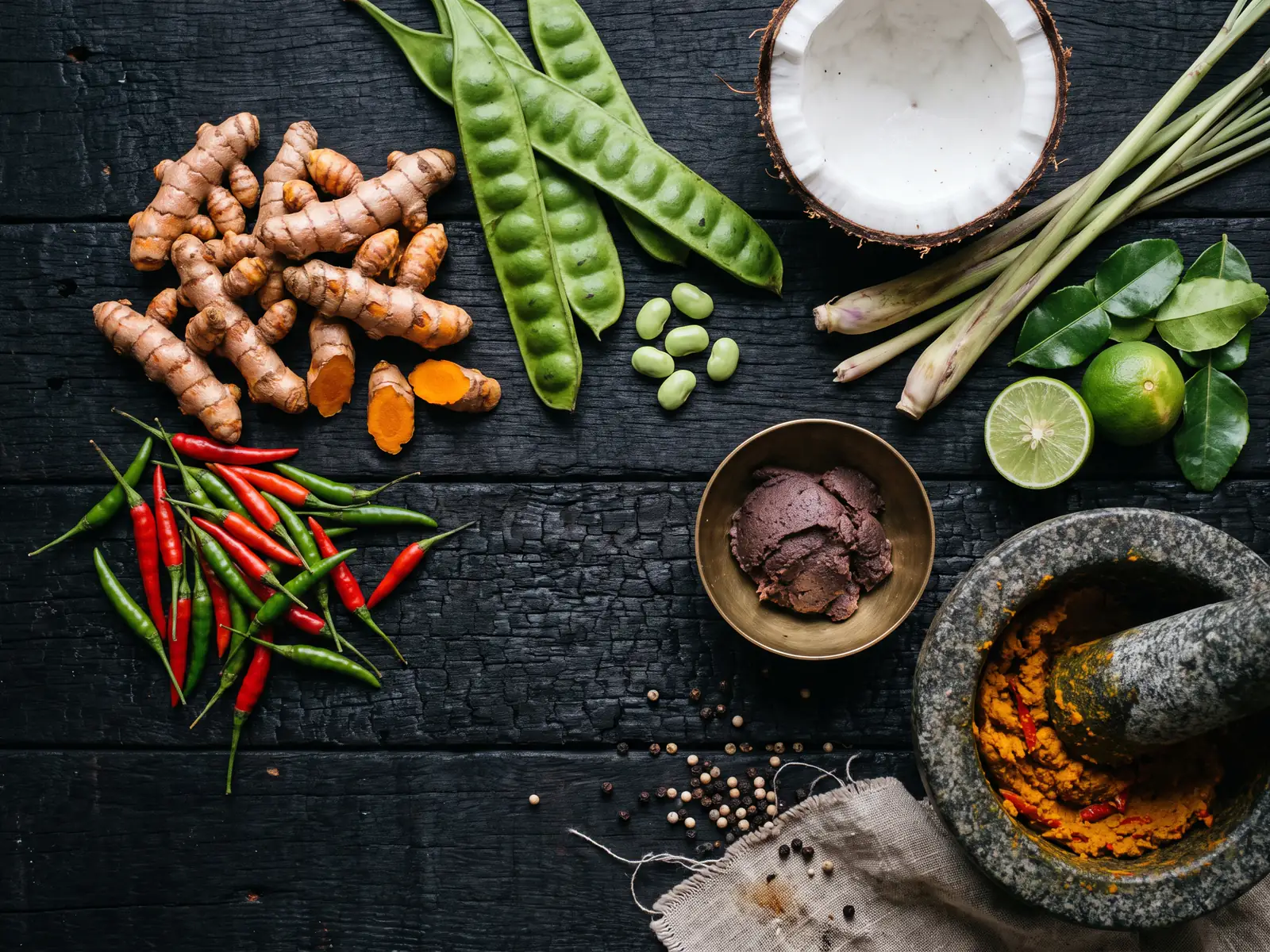
Turmeric comes first. Fresh turmeric is a defining ingredient of the south, according to overviews of Thai cuisine, and it is why so many southern curries are yellow or orange. It is used generously with seafood, partly to counter a fishy smell.
Souring and salting come next. Garcinia (ส้มแขก, a dried sour fruit), tamarind and palm fruit supply the acidity, while shrimp paste (gapi), fish sauce and salt supply the savour. Shrimp paste and fish sauce run right through this cooking, which matters if you avoid fish or shellfish. The guide to vegetarian and vegan Thai food explains where they tend to hide and how to ask about them.
Sator (สะตอ, Parkia speciosa), known in English as the stink bean, grows in flat green pods holding large beans. It is typically stir-fried with shrimp and shrimp paste, and is also eaten raw or pickled. Do not confuse it with luk niang (ลูกเนียง), jengkol, which is a different bean. Jengkol carries a documented risk of kidney toxicity from djenkolic acid, so it is not something to eat casually.
Liang leaves (ใบเหลียง, Gnetum gnemon), often stir-fried with egg, are described as a southern vegetable. Coconut milk enriches some southern curries (wai khua, further down, is one) but not all, as the sour curry shows.
Dishes worth knowing
These are dishes of southern cooking in general. Whether any particular kitchen on Samui makes them is a separate question, and nothing here says otherwise.
Khua kling (คั่วกลิ้ง)
What is khua kling? Minced meat dry-fried with southern curry paste. There is no sauce to speak of: the fat renders out as the meat cooks, and the paste clings to the meat instead of dissolving into liquid. What you taste is largely the paste, at full strength.
Gaeng tai pla (แกงไตปลา)
A very hot curry built on tai pla, a salty sauce made from fermented fish innards, with vegetables and fish added. Gaeng tai pla is associated with the south and particularly with Phatthalung. Sources describe the innards in different ways (entrails, guts, stomach, liver), so the Thai name is the safer one to remember.
Pad sator (ผัดสะตอ)
Sator stir-fried with shrimp and shrimp paste is the usual way the bean is eaten cooked. The pods and beans have the pungent character that earned the plant its English name, so it is a dish that sorts people quickly into those who like it and those who do not.
Khao yam (ข้าวยำ)
A rice salad of herbs, toasted coconut and dried shrimp, dressed with budu, according to the Michelin Guide's anatomy of the dish. It is more likely of Malay derivation, and the dressing varies by province. Budu) is a fermented anchovy-and-salt sauce from the Malay communities of the Deep South (Yala, Narathiwat and Pattani), so it belongs to that part of the south more than to the whole of it.
Moo hong (หมูฮ้อง)
Braised pork belly with garlic, black pepper and coconut sugar, a reminder that coconut sugar does as much work in savoury southern cooking as it does in the island's sweets. It is one of the few southern specialities that plays down spice, and it is associated with Phuket and with Hokkien Chinese cooking, a reminder that the south is not only a story of chilli.
The southern sour curry belongs on this list too, but it has a naming problem that deserves its own section.
The yellow curry confusion
Two different curries answer to the name yellow curry, and they behave in opposite ways at the table.
The first is gaeng kari (แกงกะหรี่), the mild, coconut-rich, Indian-influenced yellow curry most visitors know. It is the one our guide to Thai food spice levels lists among the mildest curries, because it generally contains less chilli than the others.
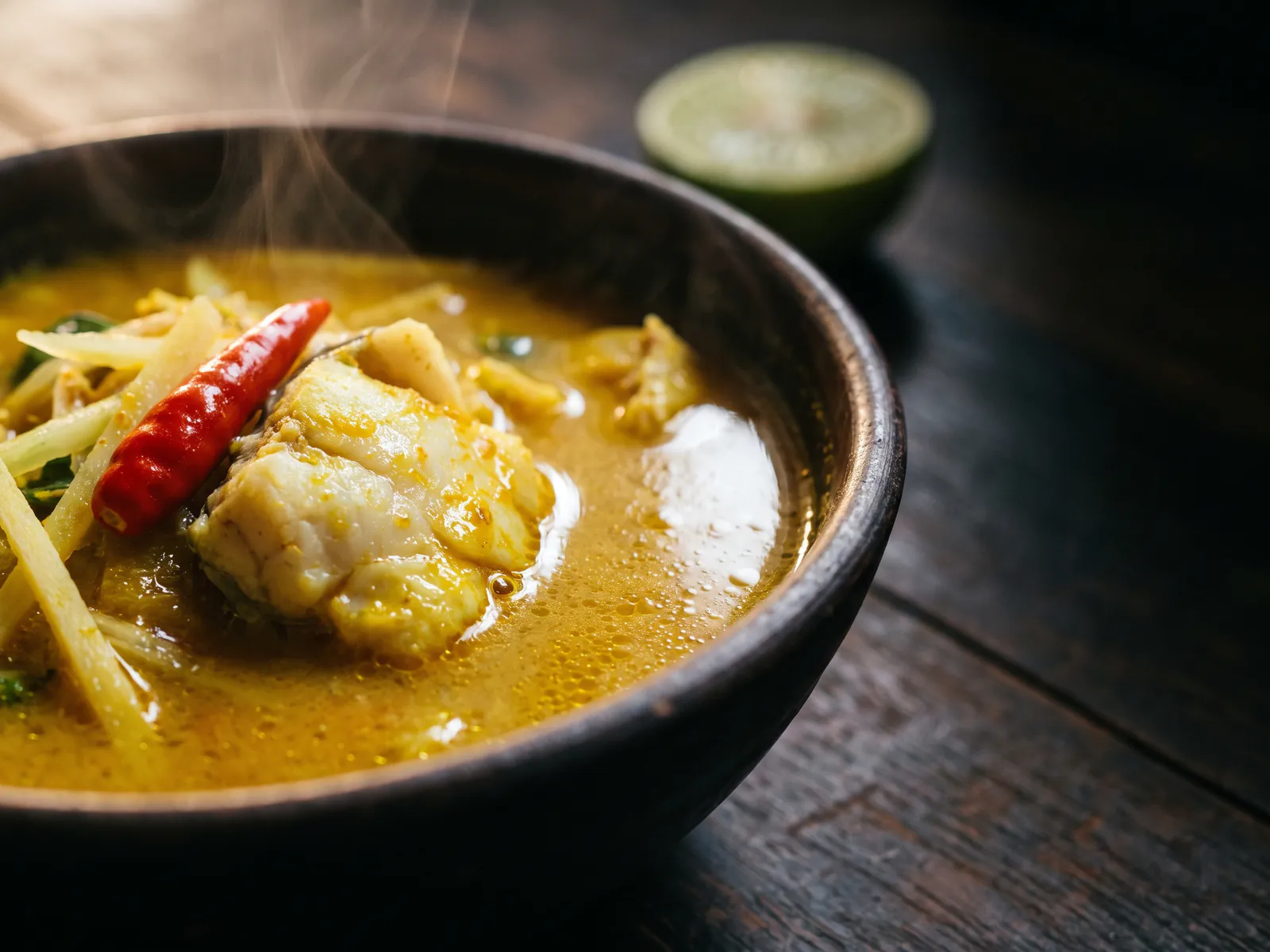
The second is the southern sour curry. Southern cooks call it gaeng som (แกงส้ม), and elsewhere it is often called gaeng leuang (แกงเหลือง), which literally means yellow curry. It is turmeric-yellow, sour and hot, soured with tamarind or garcinia, and it contains no coconut milk.
| Feature | Gaeng kari (แกงกะหรี่) | Southern sour curry (แกงส้ม / แกงเหลือง) |
|---|---|---|
| Taste | Mild and rich | Sour and hot |
| Coconut milk | Yes, a coconut-rich curry | None |
| Colour | Yellow, from turmeric | Turmeric-yellow |
| Character | Indian-influenced | Southern, soured with tamarind or garcinia |
| Heat | Generally milder than other Thai curries, with less chilli | Hot |
What is actually local to Samui and Surat Thani
Samui is an island within a province, and the two are easy to blur. Start with the island. Chinese immigrants established its coconut plantations, and coconut was historically the island's main cash crop, a history also recorded in a southern Thailand information archive hosted by Prince of Songkla University. It is the clearest local thread in the cooking, though it says little about any one dish.
The dish most firmly tied to the island is wai khua (วายคั่ว), a Samui and Phangan coconut-milk curry of wai, a local dialect word for a small cephalopod, flavoured with lemongrass and shrimp paste. Sources disagree on whether wai is small squid or octopus, so it is safest to say small squid or octopus. The Michelin Guide's Samui notes also describe a Samui stir-fried squid with pineapple as a local recipe found only on the island, and say its Bib Gourmand selections include local and southern kitchens.
Then there are the famous products of Surat Thani province that are not from the island at all. They are worth knowing as provincial pride, but they are mainland foods:
- Surat Thani oysters are a registered geographical indication product, registered in 2006 and farmed in Ban Don Bay, in the Chaiya, Tha Chang, Phunphin, Mueang and Kanchanadit districts. The registered area does not include Koh Samui.
- Chaiya salted egg (ไข่เค็มไชยา) is a geographical indication product of Chaiya district on the mainland, known for a large, sandy-textured yolk.
- Surat Thani turmeric (ขมิ้นชันสุราษฎร์ธานี) was registered as a geographical indication in 2022, which fits a region whose cooking leans so heavily on the root.
What gets called southern but is not
Because Samui is in the south, anything Thai eaten on it can drift into being labelled southern. A few corrections cover most of the errors.
| Dish | Where it actually belongs |
|---|---|
| Khao soi (ข้าวซอย) | Northern Thailand |
| Pad kra pao (ผัดกะเพรา) | A Bangkok dish, central rather than southern |
| Khao man gai (ข้าวมันไก่) | The Thai version of Hainanese chicken rice, carried here by Chinese immigrants |
| Tom yum goong, pad thai, som tam, mango sticky rice | National dishes, eaten everywhere, so not markers of any one region |
| Massaman curry (แกงมัสมั่น) | Contested: some scholars place it in the 17th-century Ayutthaya court, which is central, while other accounts call it southern and Malay or Indian influenced |
| Hat Yai fried chicken (ไก่ทอดหาดใหญ่) | Songkhla, in the south but not on Samui |
| Gai kolae (ไก่กอและ) and budu (บูดู) | The Deep South: Thai government material names a village in Pattani as the origin of this Malay-Muslim grilled chicken |
None of these is a Samui dish. Some are southern in the wider sense, and some are not southern at all, but none belongs to the island. It also helps to remember that the south is not one kitchen: the Malay-Muslim cooking of the Deep South sits a long way from an island kitchen in Surat Thani.
Eating it: the vegetable plate, the heat and where to go next
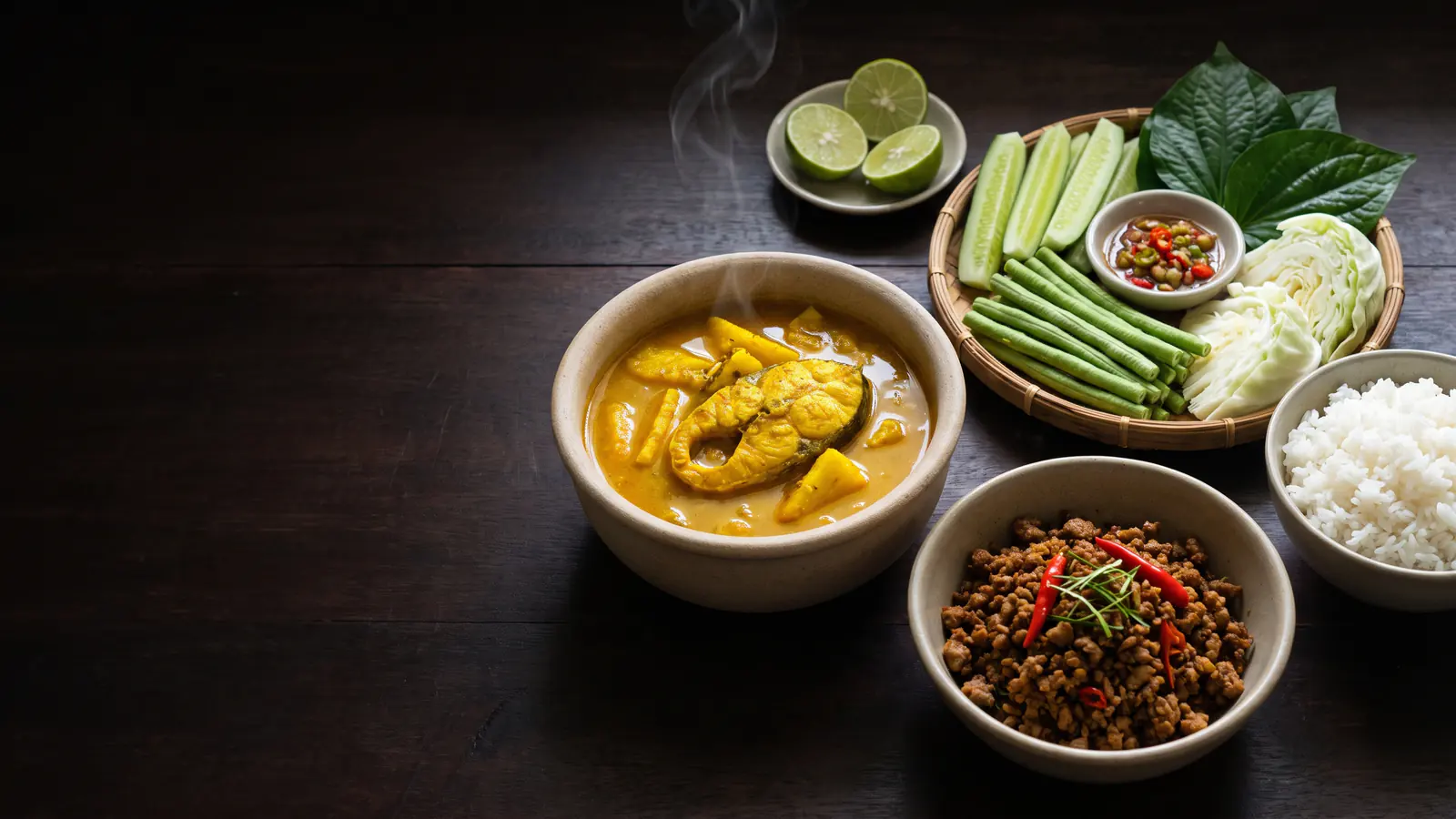
Southern food is rarely eaten alone. Fresh raw vegetables and herbs (ผักเหนาะ, phak nho) are served alongside to offset the heat, usually with a chilli relish, and the same habit is described in one guide to eating in Koh Samui. Cucumber, long beans, cabbage and leaves are the kind of thing to expect. Use the plate: a bite of something crisp between mouthfuls of a hot curry is what it is for.
If heat is the worry, say so plainly when you order. The spice-levels guide has the Thai phrases for it, and the guides to ordering food in Thai and Thai dining etiquette cover the practical side of the table. For a sense of what meals around the island generally cost, there is a guide to Koh Samui food prices.