Thai Sweets on Koh Samui: Coconut, Palm Sugar and Banana Leaf
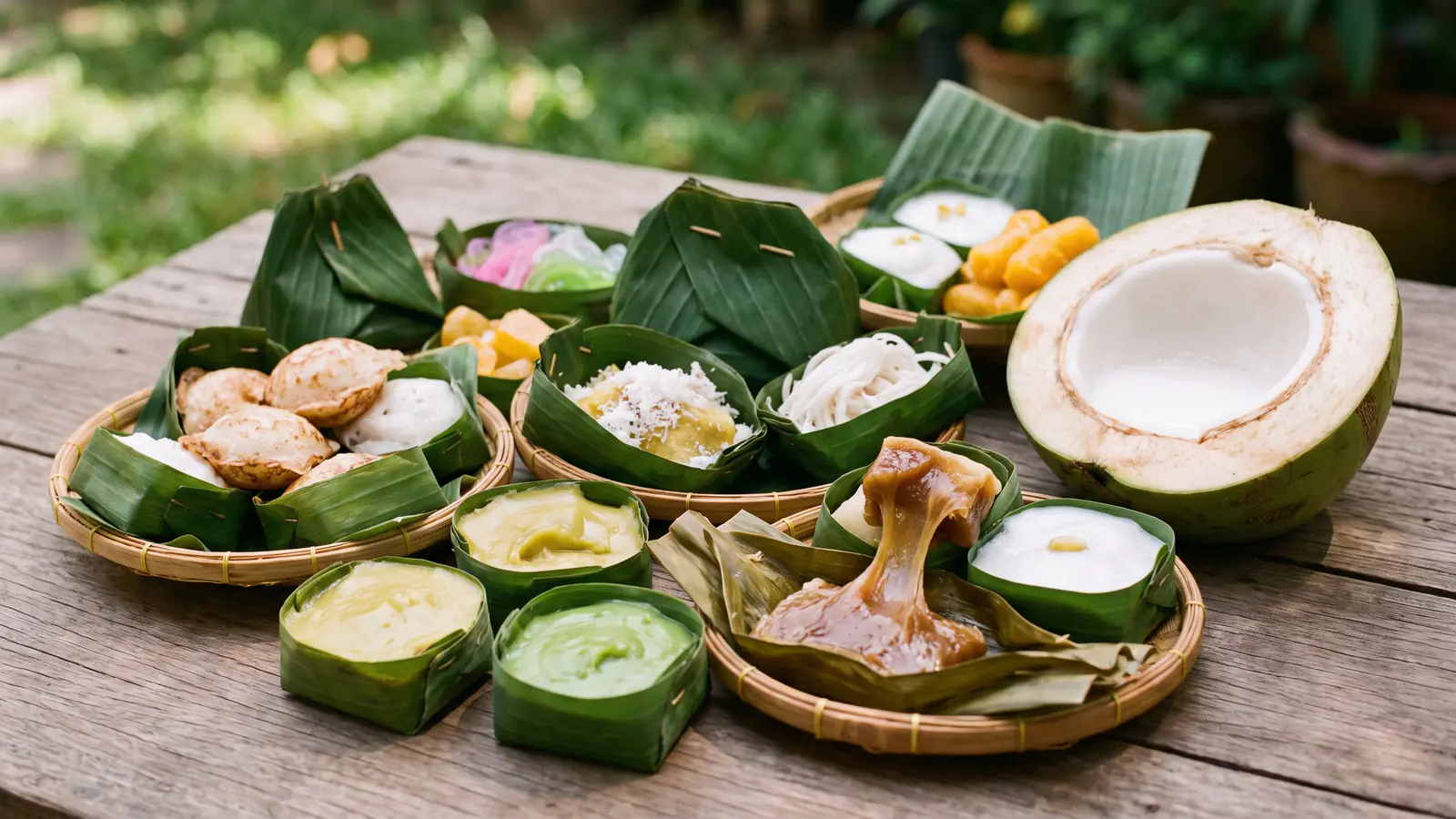
Thai sweets look like a long list of unrelated names until you notice how short the list of materials is. Coconut in three forms (milk, cream and grated flesh), palm sugar, rice and rice flour, pandan and banana leaf account for most of what sits on a market tray. Once those are familiar, a stall of unfamiliar sweets starts to read as one family.
Koh Samui is a fair place to learn that, because coconut is part of the island's history. This is an explainer for a visitor, not a ranking. It covers what the sweets are made of, the handful you are most likely to meet, the gold egg-yolk sweets with their Portuguese story, a slow-stirred sweet that is made on the island, and what to know if you avoid eggs or shellfish.
Everything is built from the same few things
The general Thai word for a sweet or snack is ขนม (khanom), and it is worth recognising on any sign. The guide to reading a Thai menu covers the rest of the vocabulary. Behind the word, nearly every khanom comes back to the same materials:
- Coconut milk and coconut cream, which do the work that dairy does in other cuisines. Khanom krok, for example, takes coconut milk in the batter and a coconut cream topping. Grated coconut flesh is the third form, and shredded coconut is among the optional components of khanom krok.
- Palm sugar, made by boiling collected sap until it thickens and ranging in colour from golden brown to nearly black. In Thailand it comes mainly from coconut palm blossom or from the palmyra palm, and Thai Wikipedia describes a rich, mellow sweetness (รสหวานมัน) unlike the sharper taste of granulated sugar.
- Rice, in two forms: glutinous rice, which is cooked or stirred into sweets, and rice flour, which makes batters and the strands in lot chong.
- Pandan (ใบเตย), the leaf that gives green colour and fragrance. It is behind the green of lot chong and the scent of khanom tuay.
- Mung bean, sometimes as a filling, as in khanom khai hong, where the paste is sweetened with coconut milk and fried.
- Banana leaf, which is both wrapper and cooking vessel. Steaming in it imparts a subtle sweet flavour and aroma, and the leaf keeps juices in and protects food from burning.
That short list works as a filter. A green strand or jelly usually owes its colour and scent to pandan. A dark, chewy sweet usually rests on palm sugar. A sweet in a leaf parcel or a small ceramic cup has usually been steamed.
Coconut, and why this island in particular
Coconut is the thread that ties Samui to its sweets. According to Wikipedia's account of the island, Chinese immigrants began cotton and coconut plantations there from the 19th century and shipped the harvest to the mainland by boat, and before tourism arrived the island's economy rested on exports of coconut and cotton. The southern food guide tells that history and what it means for savoury cooking, so it is not repeated here.
What follows for sweets is modest, and worth stating plainly. Samui did not invent the sweets in this article. Khanom krok, lot chong and mango sticky rice are eaten across Thailand, and the first two have close cousins elsewhere in Southeast Asia. What the island supplies is context. Coconut is part of its past, which makes coconut a sensible lens: almost every sweet below, apart from the gold egg-yolk ones, is some combination of coconut milk, coconut cream and palm sugar.
The sweets you will actually meet
These are Thai sweets in general, found well beyond the island. Thai script is given alongside the romanisation because spellings vary from one sign to the next.
Khanom krok (ขนมครก)
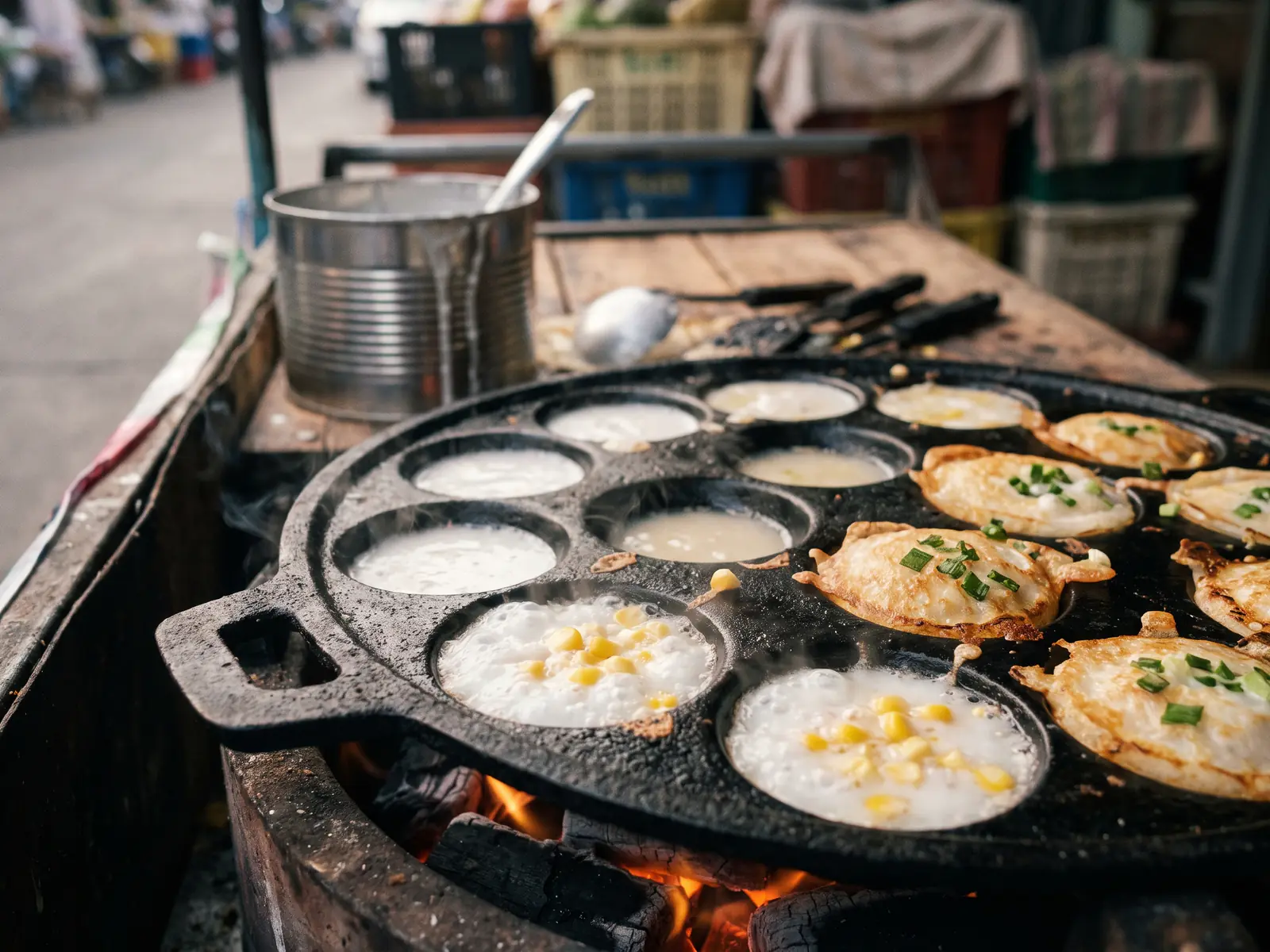
A batter of rice flour, sugar and coconut milk is poured into a heavy pan of half-sphere hollows and topped with a spoonful of coconut cream. Per Thai Wikipedia, it is cooked over charcoal, lifted out and traditionally set together in pairs, so that two half-spheres make one ball. One description has the edges crisp and the centre soft, and the most common toppings are taro, corn and spring onion. Some versions carry shrimp, which matters if you avoid shellfish.
Khanom tuay (ขนมถ้วย)
A small steamed custard in a little ceramic cup, the ถ้วยตะไล that gives the sweet its name. Thai Wikipedia describes two layers: a base of rice flour, coconut milk and sugar, and a layer of coconut cream on top, with pandan used for colour and fragrance and some cooks adding salt or egg. It was once made for occasions such as weddings and ordinations, and is now sold at street shops and commonly eaten alongside boat noodles.
Mango sticky rice (ข้าวเหนียวมะม่วง)
Sticky rice, coconut milk, salt, palm sugar and mangoes, with the rice sweetened with the coconut milk and more of it drizzled over, according to Wikipedia. The part visitors do not expect is the season. The dish is usually eaten during the peak mango season of April and May, and the Michelin Guide puts that peak across the hot season, March to May, while noting that the popular nam dok mai variety is sold year-round. So the dish is still around outside those months, but the fruit is no longer at its seasonal peak.
Kluay buat chi (กล้วยบวชชี)
Bananas cooked in coconut milk with sugar and salt and served hot or cold. The name is the interesting part: buat chi refers to the white clothing of a chi, a Thai nun, and the pale colour of the finished dish is compared with it. Thai Wikipedia adds that it was taken to temples as an offering and served at housewarmings.
Lot chong (ลอดช่อง)
Green strands of rice flour in sweetened coconut milk, with palm sugar syrup, typically over shaved ice. Pandan supplies the green. The name can be translated as gone through a hole, after the way warm dough is pressed through a sieve. Lot chong is the Thai name for what is called cendol elsewhere in the region, a word that comes from an Indonesian term for a bump or bulge, referring to the shape of the strands. Thai Wikipedia describes the sweet as popular across Thailand with origins shared across Southeast Asia.
The gold sweets and their Portuguese past
Thong yip (ทองหยิบ), thong yot (ทองหยอด) and foi thong (ฝอยทอง) sit apart from the coconut sweets. All three are made from egg yolk and sugar syrup, and thong in each name means gold. Thai Wikipedia notes thong yip is used as a sweet on auspicious occasions such as weddings and housewarmings. Thong yip is yolk whipped until fluffy, dripped into boiling syrup and gathered into small cups. Thong yot is made from egg yolks, flour and sugar, and foi thong is yolk drawn into thin strands and boiled in sugar syrup, which gives the golden threads.
Each has a Portuguese counterpart: thong yip descends from trouxas das Caldas, thong yot was adapted from ovos moles de Aveiro, and foi thong is the Portuguese fios de ovos, which is believed to have been created by Portuguese nuns. The usual account of how they reached Siam credits Maria Guyomar de Pinha, known in Thai as ท้าวทองกีบม้า (Thao Thong Kip Ma). She lived from 1664 to 1728 in Ayutthaya, was of mixed Japanese, Portuguese and Bengali descent, and worked as a cook in the palace in the reign of King Narai.
Wikipedia's article on her adds that many of the desserts were yellow like gold, a colour considered auspicious in Siamese tradition. It also records that historians disagree about how much was her own work. One critic argues that only foi thong and thong yip can be fully credited to her, and others say some of the sweets already existed as convent sweets. The safe version is that these are Portuguese-descended sweets, long adopted into Thai ceremony, and that her name is the traditional one attached to the story.
Kalamae, the slow one
Kalamae (กะละแม) is a dark, sticky sweet, closer to a chewy toffee than to a cake, and it is a traditional sweet made on Koh Samui. According to a recipe page about a Samui kalamae maker, Samui people call it กัมแม. It is made from glutinous rice, coconut milk and palm sugar, stirred for more than ten hours until it reaches the right chewy texture.
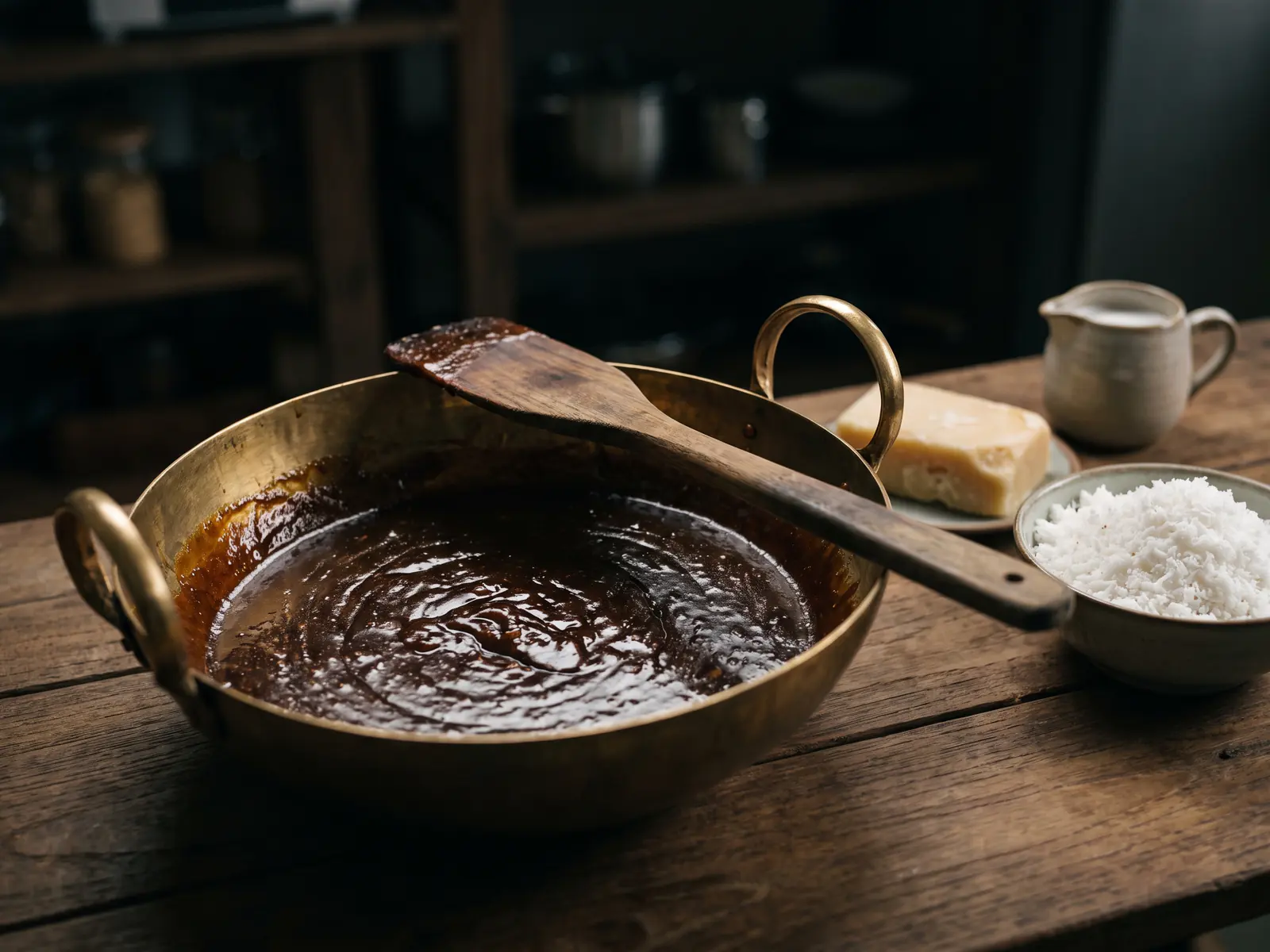
The same page says it was traditionally made to feed guests at merit-making ceremonies, and that the labour meant only well-off households with plenty of helpers could manage it. It also says that some people who make and sell kalamae on the island have changed the traditional method, and that its subject opened a shop to keep the older version, made with whole rice grains rather than flour. Thai Wikipedia describes the same split, between a traditional grain version and a flour-based one that is more common today because it is easier to make.
Kalamae is also a Thai sweet known well beyond the island: Thai Wikipedia lists it among the customary treats prepared before Songkran. The fair way to see the Samui version is as an island's hand-stirred take on a widely known sweet, made and sold locally and sold as a gift to take home.
Where sweets turn up
Sweets show up in three kinds of place, and the same sweet can belong to more than one.
- Stalls and street shops. Khanom tuay is sold at street shops and is commonly eaten alongside boat noodles, and khanom krok is cooked in its pan over charcoal, so a stall that makes it is easy to recognise by the pan alone.
- Occasions. Thong yip is used at weddings and housewarmings, kluay buat chi is taken to temples as an offering, and kalamae was traditionally made for merit-making. Many sweets that are a snack in one setting are ceremonial in another.
- Gifts. Kalamae is sold as a gift to take home.
This article deliberately names no stalls, markets or days. Opening patterns change and are best checked locally. For what a meal costs around the island, see the Koh Samui food prices guide, and for the area around Choeng Mon the Choeng Mon area guide is the place to start.
What is and is not in them
A sweet that looks like coconut and rice can still contain egg. The gold sweets are egg yolk by definition. The baked custard khanom mo kaeng (ขนมหม้อแกง) is made with coconut milk, eggs and palm sugar, and some khanom tuay recipes add egg. Khanom krok can carry shrimp.
Dairy works the other way round. Coconut milk, not dairy, does most of the work in Thai sweets, but milk does enter some desserts as condensed or evaporated milk, as the guide to vegetarian and vegan Thai food explains. That guide also has the phrases for asking, which is the right route for anyone who needs certainty about egg, dairy or shellfish. Recipes vary by cook, and nothing here is a guarantee about any particular sweet.